Xiamen Tmax Battery Equipments Limited was set up as a manufacturer in 1995, dealing with lithium battery equipments, technology, etc. We have total manufacturing facilities of around 200000 square foot and more than 230 staff. Owning a group of experie-nced engineers and staffs, we can bring you not only reliable products and technology, but also excellent services and real value you will expect and enjoy.
Solid-State Battery Assembly Line: Advanced Mechanical Equipment for Next-Generation Energy Storage
Overview
A Solid-State Battery Assembly Line is a sophisticated mechanical system designed for the automated fabrication of solid-state batteries (SSBs). Unlike conventional lithium-ion batteries, solid-state batteries replace liquid electrolytes with solid electrolytes, offering higher safety, energy density, and cycle life. Assembly lines dedicated to solid-state batteries integrate multiple processing modules to ensure precise electrode preparation, electrolyte handling, layer stacking, and final cell assembly. These systems are crucial for both laboratory-scale development and industrial-scale manufacturing of high-performance energy storage solutions.
The assembly line provides a controlled and scalable platform, minimizing contamination risks associated with moisture-sensitive solid electrolytes while maintaining high throughput. It supports standardized production and rapid iteration of battery prototypes, bridging the gap between experimental research and commercial deployment.
Features
Modern solid-state battery assembly lines incorporate several key features to optimize performance, efficiency, and quality:
1. Automated Electrode Handling
Electrodes are coated, dried, cut, and calendered with high precision to ensure uniform thickness and consistent porosity, which are critical for cell performance.
2. Solid Electrolyte Integration
Specialized modules handle solid electrolytes, including ceramic, sulfide, or polymer-based types, ensuring uniform deposition and intimate contact with electrodes.
3. Layer Stacking and Lamination
High-precision robotic systems stack and align multiple electrode-electrolyte layers, ensuring structural integrity and minimizing internal defects.
4. Controlled Environment Chambers
Assembly occurs in inert atmospheres or dry rooms to protect moisture- and oxygen-sensitive materials, preventing degradation of solid electrolytes.
5. Sealing and Packaging Units
Hermetic sealing, pouch lamination, or casing modules provide mechanical stability and environmental protection for completed cells.
6. In-Line Testing and Quality Control
Integrated sensors and automated measurement systems monitor parameters such as thickness, alignment, voltage, internal resistance, and capacity in real time.
Process
The solid-state battery assembly line follows a sequential, controlled workflow to ensure high-quality cell production:
1. Electrode Preparation
Active materials are mixed with binders and conductive additives, coated onto current collectors, and dried. Precise calendering ensures optimal density and porosity.
2. Solid Electrolyte Layer Formation
Solid electrolytes are cast, pressed, or extruded into thin, uniform layers suitable for integration into the cell stack.
3. Layer Assembly
Electrodes and solid electrolytes are stacked or laminated using robotic systems, ensuring precise alignment and intimate contact between layers.
4. Cell Sealing
Assembled stacks are encapsulated in hermetic pouches, rigid casings, or laminated films to prevent environmental contamination.
5. Formation and Testing
Cells undergo initial charge-discharge cycles, capacity measurement, and impedance testing to verify electrochemical performance and structural integrity.
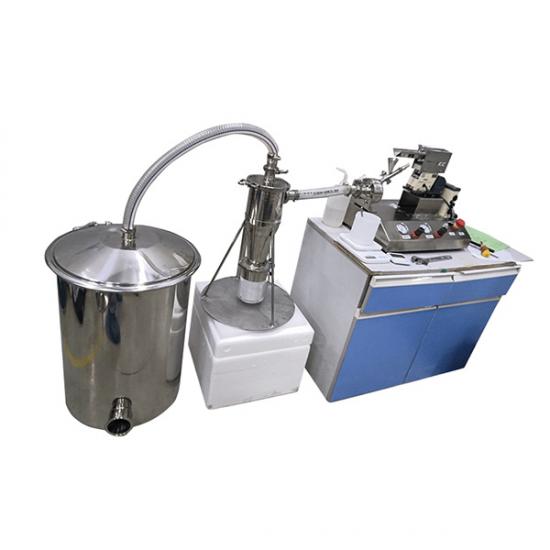
Air Flow Fibrosis Machine
Applications
Solid-state battery assembly lines are utilized across multiple industries and research areas:
* Electric Vehicles (EVs)
Production of high-energy-density, safe batteries for passenger vehicles, buses, and commercial transport.
* Grid Energy Storage
Manufacturing of large-format solid-state cells for renewable energy storage and stabilization of electrical grids.
* Consumer Electronics
Fabrication of compact, high-performance SSBs for smartphones, laptops, wearables, and other portable devices.
* Aerospace and Defense
Lightweight, robust, and thermally stable SSBs are ideal for aerospace applications and harsh environmental conditions.
* Research and Development
Enables rapid prototyping and testing of novel solid-state chemistries, electrode formulations, and electrolyte materials.
Advantages
Solid-state battery assembly lines offer numerous benefits over conventional battery manufacturing methods:
1. Enhanced Safety
Solid electrolytes eliminate flammable liquids, reducing risks of leakage, fire, and thermal runaway.
2. High Energy Density
Optimized electrode and electrolyte layers allow more energy storage per unit volume compared to traditional lithium-ion cells.
3. Extended Cycle Life
Controlled assembly and precise layer alignment reduce degradation, extending battery lifespan.
4. Automation and Scalability
Integrated robotic systems and in-line monitoring enable high-throughput, reproducible production.
5. Environmental Control
Dry rooms and inert atmosphere chambers protect sensitive materials, ensuring long-term stability.
6. Versatility
Supports multiple cell formats (pouch, prismatic, cylindrical) and different solid-state chemistries, allowing flexible manufacturing and experimentation.
Conclusion
The Solid-State Battery Assembly Line is a critical mechanical system for the production of advanced energy storage devices. By integrating electrode fabrication, solid electrolyte handling, precise layer stacking, sealing, and in-line testing, these assembly lines ensure the consistent production of safe, high-energy-density, and long-lasting solid-state batteries.
With applications in electric vehicles, grid storage, consumer electronics, aerospace, and research, solid-state battery assembly lines are central to the development and commercialization of next-generation energy storage technologies. Their automation, environmental control, and versatility enable both scalable manufacturing and experimental innovation, making them indispensable for the future of battery technology.



 ipv6 ağı desteklenir
 tr
tr en
en fr
fr de
de ru
ru es
es pt
pt ko
ko pl
pl th
th


